
USHL Player Hometown Map: Where USHL Players Come From
Updated: Sep 16
(and How They Connect to NHL Talent Pipelines)
USHL Hometown Trends and Talent Pathways
The United States Hockey League (USHL) is the top junior league in the United States and one of the most important talent gateways into NCAA Division I hockey and eventually the NHL. The geographic patterns seen in junior hockey often predict where future NHL talent will come from, and when you compare these USHL results with the NHL hometown data, the connection becomes impossible to miss.
Below is the data behind the USHL player hometowns infographic, followed by insights into how different regions fuel the league’s player pool. For a fully interactive view of where these athletes come from, explore the USHL Hometown Map. For a complete guide on how this geographic depth funnels into the NCAA and NHL, explore our full League Pathway Guide.

North America Still Drives the USHL, And That Mirrors the NHL
Just like the NHL, the USHL is overwhelmingly North American. But the proportions, and the reasons behind them, differ in meaningful ways.
United States
The U.S. produces 286 USHL players, making up the backbone of the league.
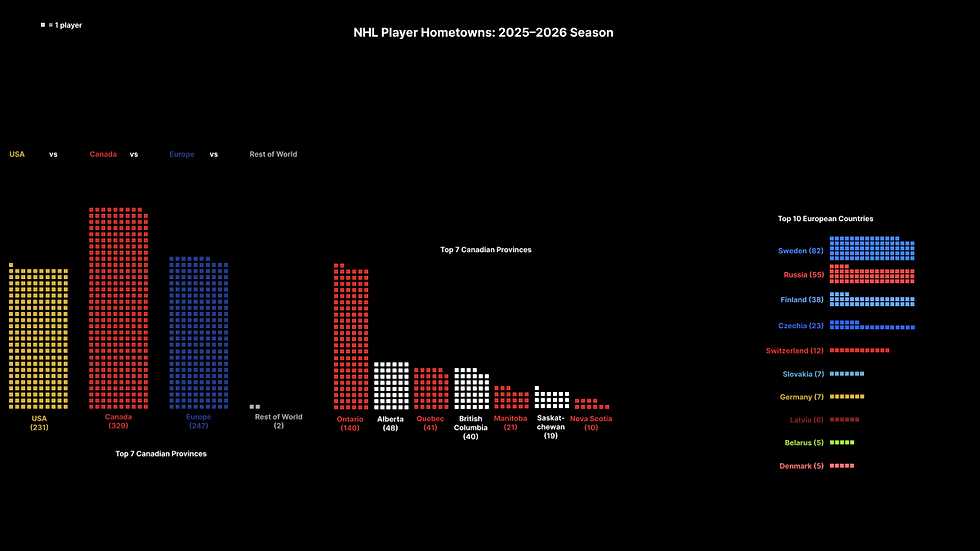
This aligns directly with the NHL picture, where the United States provides 231 NHL players.
The reason is straightforward:
• U.S. development systems (AAA, prep, high school, USHL/NAHL) feed directly into NCAA hockey
• NCAA feeds directly into the NHL
• The USHL is the prime launchpad for NCAA-bound prospects
In other words, the USHL → NCAA → NHL pipeline is fully intact, and the geographic dominance of U.S. players at the junior level naturally carries upward.
Canada
Canada contributes 30 USHL players, far fewer than the United States, but the story changes dramatically at the NHL level.
The NHL dataset showed that Canada produces 329 NHL players, the single largest talent pool in the sport.
This gap makes sense:
• Canada’s development pathway flows through CHL (OHL, WHL, QMJHL), not the USHL
• Only families prioritizing NCAA routes send players to the USHL
• Canadian talent doesn’t appear junior-heavy in this league, but it heavily saturates the pro ranks
Thus, the USHL is not a Canadian pipeline, but Canada still dominates NHL output through entirely different systems.
Europe
Europe sends 55 players to the USHL in total, concentrated among a few primary nations:
• Sweden (13)
• Czechia (13)
• Slovakia (10)
• Finland (7)
• Latvia (5)
Meanwhile, the NHL shows a far broader and deeper European presence:
• Europe totals 247 NHL players
• Sweden alone contributes 82 NHL players
• Russia contributes 55 NHL players
• Finland contributes 38 NHL players
This tells you something important:
The USHL is where European prospects with NCAA ambitions go, not where Europe sends its full talent pool.
Most top tier Europeans stay within:
• SHL/J20 (Sweden)
• Liiga/U20 SM-sarja (Finland)
• Czech Extraliga/U20
• KHL/MHL (Russia)
Only a select subset pursues the North American college route. That selective group is exactly what you see reflected in the USHL numbers.
A Clear Talent Funnel Emerges
When comparing USHL to NHL data, you can see the development funnel tighten:
The USHL is heavily American
→ because NCAA is heavily American→ because U.S. hockey development is built around education-first pathways→ and NCAA is the strongest pipeline to the NHL for American-born talent
Canada dominates NHL numbers
→ but is underrepresented in the USHL→ because the CHL is the premier Canadian development engine→ and CHL players are ineligible for NCAA, so they do not pass through the USHL system
Europe sends only a slice of its players to the USHL
→ but those who come are often highly motivated, academically eligible, English-speaking prospects→ and many eventually become NCAA standouts and mid-to-late-round NHL draft picks
The USHL dataset is not meant to mirror the NHL.
It is the front end of the NCAA → NHL pipeline, while the CHL is the front end of the Canada → NHL pipeline, and domestic junior leagues are the front end of the Europe → NHL pipeline.
Together, these three systems produce the regional structure you see at the NHL level.
What the Numbers Inside USHL Player Hometowns Data Reveal About NCAA and NHL Recruiting
1. Minnesota and Michigan Still Dominate U.S. Junior Talent
Just as they are overrepresented in NCAA hockey and NHL drafts, these states form the backbone of USHL American player production.
2. Sweden and Czechia Lead European NCAA Pipelines
Both countries sent 13 players each, exactly matching the trend seen in NCAA commitments in recent years.
3. Slovakia’s Rapid Growth is Real
With 10 USHL players, Slovakia is no longer a fringe contributor.
This mirrors their surge in NHL draft relevance (Slafkovský, Nemec, Mešár).
4. The USHL Is Becoming a Gateway for Nontraditional markets
Countries like Latvia, Belarus, and Norway each appear in the dataset, small numbers, but historically meaningful.
Why This Analysis Matters for Player Development
Understanding where junior players originate helps players, parents, and coaches understand:
• which regions reliably produce NCAA recruits
• where scouting investment is flowing
• which countries are increasingly using the NCAA path
• how USHL exposure translates to NHL opportunities
• what the true North American vs. European balance looks like across levels
The 2025 to 26 USHL data shows a league shaped by education-first development, regional dominance, and a growing European influence, all of which naturally feed into the talent landscape observed at the NHL level.
Check out how this compares to the NHL Map.
Want to go deeper? Visit our complete Hockey Player Development Guide to explore every resource, article, and strategy for helping your player grow the right way.
Use our Hockey Development Infographics to bring clarity to your website, newsletter, or team resources. Each visual includes a ready-to-use embed code and credit link.


Comments